
Best Non-Toxic Air Fryers 2026
Most air fryers sold today have baskets coated with nonstick materials that weren’t designed to be heated to 400°F repeatedly, by millions of households, with cooking spray blasted directly onto them. The “non-toxic” label gets applied loosely — sometimes to products that replaced PTFE with ceramic coatings of unknown formulation, sometimes to appliances that are coating-free on the basket but loaded with plastic internal components. At ecowyn.com, we evaluate these products against two standards: personal health safety and genuine environmental sustainability, because those two things are not always the same purchase.
What Makes an Air Fryer Toxic — And Why It Matters More Than You Think
The health concerns around air fryers aren’t theoretical. They involve specific chemicals, specific temperatures, and specific populations who face greater risk than others. Understanding the actual mechanisms helps you evaluate product claims rather than just accepting marketing language.
PFAS and PTFE: The Coating Problem at High Heat
PTFE — polytetrafluoroethylene, sold under the brand name Teflon — is the classic nonstick coating found in the majority of air fryer baskets. It belongs to a broader class of chemicals called PFAS (per- and polyfluoroalkyl substances), sometimes called “forever chemicals” because they don’t break down in the environment or in the human body.
Under normal cooking conditions, PTFE is relatively stable. The problem is that air fryers run hot. PTFE coatings begin to break down and release fumes above 260°C (500°F) — a threshold some air fryers can reach during high-heat cooking cycles, according to research on fluoropolymer thermal degradation. At those temperatures, PTFE releases ultrafine particles and gases including perfluoroisobutylene, which can cause polymer fume fever in humans and is lethal to birds at low concentrations. If you have a pet bird in your kitchen, a Teflon-coated air fryer is a genuine acute risk.
Beyond acute exposure, PFAS compounds including PFOA (perfluorooctanoic acid) and PFOS (perfluorooctane sulfonate) have been linked to thyroid disease, certain cancers, immune disruption, and developmental harm in children. PFOA was phased out of US manufacturing by 2013, but many imported products still use older formulations. And “PFOA-free” is not the same as PFAS-free — there are over 12,000 compounds in the PFAS family.
The secondary concern is coating degradation over time. A basket with intact PTFE presents lower risk than one that’s been scratched with metal utensils or scrubbed with abrasive pads. Once the coating starts flaking, you’re likely ingesting fragments directly — and they’re small enough that you won’t see them.
Ceramic Coatings: Safer, But Not the Full Story
Ceramic-coated baskets have become the default “upgrade” in the non-toxic air fryer market, and they’re genuinely preferable to PTFE in one important way: they don’t contain PFAS. That’s real progress. But “ceramic” is a broad marketing term covering a wide range of sol-gel coatings with very different formulations, and the category deserves more scrutiny than it typically gets.
Some ceramic coatings incorporate nanoparticles — particles in the 1–100 nanometer range — including titanium dioxide and silicon dioxide. These compounds may be inert at room temperature, but their behavior at sustained high heat, particularly regarding nanoparticle migration into food, isn’t fully established in peer-reviewed literature. The European Food Safety Authority has raised questions about titanium dioxide specifically, and France banned it as a food additive in 2020.
The other problem is disclosure. Most brands that describe their baskets as “ceramic coated” don’t publish the full formulation. Without that transparency, you can’t evaluate what’s actually in it. A ceramic label tells you what the coating doesn’t contain (PFAS) but not what it does contain. For readers who are pregnant, have young children, or are managing health conditions influenced by endocrine disruptors, that gap matters.
Plastics, Phthalates, and BPA in Air Fryer Components
The basket coating gets most of the attention, but it’s not the only material concern. Air fryers contain plastic components — exterior housing, internal dividers, sometimes the drawer mechanism itself — that are exposed to heat and airflow during cooking. Plastics can off-gas phthalates and BPA (bisphenol A), both known endocrine disruptors, particularly when heated.
Most premium non-toxic air fryers have addressed the basket and cooking surface, but fewer have disclosed the composition of every plastic component. When evaluating any air fryer for a household with young children or a pregnant person, the interior plastic surfaces that come into contact with hot air circulating over your food are worth examining, not just the basket material.
Acrylamide: The Air Frying Risk No One Talks About
Here’s a hazard that has nothing to do with coatings: acrylamide. This chemical forms naturally when starchy foods — potatoes, bread, crackers — are cooked at high temperatures through the Maillard reaction. Air fryers excel at producing the crispy, browned surface that triggers exactly this reaction.
The World Health Organization classifies acrylamide as a probable human carcinogen based on animal studies. Studies in humans show associations with certain cancers, though causal relationships are harder to establish. The practical implication: air-frying frozen french fries at 400°F until they’re very dark produces more acrylamide than cooking them at 350°F to a lighter color. This applies to all air fryers, non-toxic or not, and it’s managed through temperature and time rather than material choice.
Indoor Air Quality: What Happens When You Heat a Coated Basket
Air fryers circulate hot air at high velocity, and that air passes over every surface inside the appliance — including the coating on your basket, any plastic components, and the food itself. When coatings off-gas, those compounds become airborne in your kitchen.
A 2023 study measuring kitchen air quality during high-heat cooking found elevated levels of volatile organic compounds (VOCs) and ultrafine particles during air fryer use, with the largest spikes occurring above 375°F. However, studies indicate that air fryers generally produce fewer volatile organic compounds (VOCs) and ultrafine particles compared to traditional frying methods. Kitchens without adequate ventilation can accumulate these compounds at concentrations that exceed outdoor air quality standards within minutes of cooking.
The practical response is simple: run your range hood at high speed when air frying, crack a window, or both. A glass or stainless steel air fryer in a well-ventilated kitchen produces meaningfully less off-gassing than a coated-basket model in the same conditions.
What to Look for in a Truly Non-Toxic Air Fryer
Buying a non-toxic air fryer isn’t complicated if you know what to look for — and what to ignore.
The Safest Food-Contact Materials
1. Borosilicate glass — Chemically inert, no coatings, no off-gassing at any temperature relevant to cooking, non-porous, easy to clean. The highest material confidence you can have.
2. Stainless steel (304/18-8 grade) — Food-safe, coating-free, extremely durable, widely recyclable. Some people with nickel sensitivities may want to avoid prolonged acidic food contact, but for general use it’s the most practical coating-free material.
3. Certified ceramic (with full disclosure) — Safer than PTFE when the formulation is transparent and PFAS-free. The gap between a well-disclosed ceramic and a generic “ceramic label on an unknown coating” is significant, which is why this ranks below uncoated materials.
4. PFAS-free ceramic (without disclosure) — Better than PTFE, but you’re trusting a marketing claim rather than verified material content.
5. PTFE / Teflon / nonstick coatings — Avoid on food-contact surfaces in air fryers. The combination of high heat, circulatory airflow, and repeated use accelerates degradation.
Red Flags to Avoid on Any Product Listing
- “Nonstick coating” with no further material specification
- “PFOA-free” without “PFAS-free” (PFOA is one chemical out of thousands)
- No mention of basket material in the product description
- Interior components described only as “BPA-free plastic” with no further detail
- Very low price point ($30–$60) from an unknown brand with a ceramic claim — proper coating formulations add cost
How to Read an AB1200 Disclosure
California’s AB1200, which took effect January 1, 2024, requires manufacturers of cookware and food-related products to disclose chemicals of concern on both product packaging and online listings — making it one of the most practical tools consumers currently have for evaluating air fryer material safety.
To find an AB1200 disclosure: look for a “Chemicals of Concern” link or disclosure table on the product’s Amazon listing, brand website, or packaging. The disclosure should list specific chemical names — not just broad categories — alongside the component they appear in.
What you want to see: a disclosure that lists chemicals with “none detected” or “not present” for PFAS, PFOA, lead, and cadmium on food-contact surfaces.
Yellow flag: a disclosure that only covers the basket or pan but doesn’t address interior components.
Red flag: no AB1200 disclosure at all on a product sold in California, or a disclosure that lists PTFE or PFAS compounds on food-contact surfaces without explanation.
Not all brands proactively publish these disclosures outside California. If you can’t find one, email the brand’s customer service and ask directly. Brands with genuinely safe materials usually respond quickly and specifically. Brands with something to hide tend to respond with vague reassurances.
What “PFAS-Free” Actually Means — and What It Doesn’t
In the United States, there’s currently no federal standard or mandatory third-party certification that defines what “PFAS-free” means on a consumer appliance. Brands can make this claim on marketing materials without independent testing. This doesn’t mean the claim is false — many brands are genuinely removing PFAS from their coatings — but the claim alone isn’t sufficient verification. Look for brands that provide AB1200 disclosures, reference specific PFAS compound exclusions (such as PFOA, PFOS, and GenX), or publish third-party testing results alongside their PFAS-free claims.
GenX chemicals deserve a specific mention. GenX is a PFAS replacement compound developed by Chemours after PFOA was phased out. It’s now found in drinking water sources in multiple US states and has been associated with kidney and liver toxicity in animal studies. Some coatings marketed as “PFAS-free” were reformulated using GenX or similar short-chain PFAS alternatives that technically fall outside the original PFAS-free definition. A brand that specifically excludes GenX and HFPO-DA from its disclosures is making a more credible claim than one that simply says “PFAS-free.”
Questions to Ask Any Brand Before You Buy
1. What is the food-contact surface made of, specifically? (Not “ceramic” — what is in the ceramic coating?)
2. Is your product covered by an AB1200 disclosure? Can you link to it?
3. Has your product been third-party tested for PFAS migration into food?
4. Do your PFAS-free claims cover GenX and HFPO-DA compounds?
5. What are the interior components made of? Are any plastic parts exposed to cooking temperatures?
Brands that answer these questions with specifics — compound names, test certifications, filing numbers — have earned meaningful trust. Brands that reply with marketing language have not.
The Best Non-Toxic Air Fryers of 2026
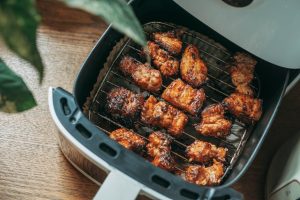
These picks were evaluated primarily on food-contact material safety, material disclosure transparency, and sustainability profile — durability, repairability, and end-of-life recyclability. Features matter too, but they’re secondary here.
Best Overall — Our Place Wonder Oven Pro
Our Place has been more transparent about materials than most appliance brands at any price point. The Wonder Oven Pro uses a stainless steel interior cavity, and Our Place publishes AB1200 disclosures that address both the oven interior and accessories. The brand has explicitly committed to PFAS-free formulations and responds to direct material questions with specifics.
The interior is stainless steel. The included baking pan has a ceramic coating that Our Place describes as PFAS-free and PFOA-free. If you want a fully coating-free setup, Our Place sells a separate stainless steel tray that fits the Wonder Oven Pro — using that instead of the ceramic pan gives you a genuinely uncoated cooking surface. The basket and tray insert is the component most in contact with food, so this swap is worth the extra cost.
On sustainability: Our Place products are built for longevity, and the brand runs a repair and replacement parts program. Stainless steel interior construction means the oven cavity itself is essentially indefinitely recyclable. The appliance also doubles as a toaster oven, air fryer, broiler, and slow cooker — consolidating functions reduces the total number of appliances in your kitchen, which has genuine environmental benefit.
Best for: Households wanting a full-size, versatile, multi-function oven with strong material transparency. Ideal for families cooking varied meals who want one appliance to handle most of it.
Honest limitations: The included ceramic baking pan is a compromise if you want zero coating exposure. The stainless steel tray is sold separately, adding cost. The Wonder Oven Pro is also large — not a compact countertop solution.
Price tier: $195–$245
Best Glass Bowl Air Fryer — Fritaire
Fritaire is genuinely different from everything else on this list. It uses a borosilicate glass cooking bowl — not a glass exterior with a coated basket inside, but an actual glass bowl that your food sits in during cooking. There’s no basket, no coated tray, no metal rack with nonstick treatment. The glass bowl is the cooking chamber.
The food-contact surface is borosilicate glass, with a stainless steel heating element. Borosilicate glass is chemically inert, non-porous, and doesn’t off-gas at any temperature used in cooking. There’s no coating to degrade, no surface that requires replacement, and no ambiguity about what your food is touching.
Fritaire also designed the bowl to be self-cleaning: add water and a drop of dish soap, run a cleaning cycle, and the high-speed air circulation does the work without scrubbing. No abrasion means no accelerated wear — which is the thing that kills most coated baskets within a couple of years.
Best for: Readers who want the highest material confidence available and are cooking for one to three people. An excellent choice for pregnant women, households with infants or toddlers, or anyone managing health conditions sensitive to chemical exposures.
Honest limitations: The glass bowl format limits how you load food — not great for flat items like toast or a whole chicken. Capacity is moderate. Glass breaks, which is an obvious practical concern in a household with young children. Fritaire is a smaller brand, and long-term parts availability is less certain than with major appliance manufacturers.
Price tier: $150–$200
Best Portable Glass Air Fryer — Ninja Crispi 4-in-1
The Ninja Crispi takes a genuinely creative approach: instead of a basket, it uses a glass cooking vessel that snaps into a power base. The food cooks in the glass container, which then doubles as a serving vessel or storage container. The cooking surface your food touches is glass — no coating, no metal basket.
Food contact is borosilicate glass. The power base and lid contain plastic components, but the cooking surface itself is glass. Ninja has published AB1200 disclosures for the Crispi line.
The glass containers are dishwasher-safe and designed to function as food storage, which means they have utility beyond the appliance itself — that reduces waste if the appliance is eventually retired. The compact form factor and lower wattage compared to full-size units mean lower energy draw per use.
Best for: Small households — one or two people — who want glass-contact cooking in a compact, affordable package. Also strong for people who do a lot of meal prep and want to cook, store, and reheat in the same vessel.
Honest limitations: The glass containers have limited capacity for family-scale cooking. The power base has plastic components exposed to heat and airflow — Ninja discloses these, but they’re present. Ninja’s overall product transparency has improved significantly, but it remains a large consumer electronics brand rather than a mission-driven sustainability company.
Price tier: $100–$130
Best Compact Option — Bella 4Qt Slim
Bella’s 4Qt Slim uses a ceramic-coated basket described as PFAS-free and PFOA-free, and at its price point it’s one of the more honest budget options. It’s genuinely compact — fits on a narrow counter with a minimal footprint.
The basket coating is more transparent than most mass-market alternatives at this price. An AB1200 disclosure is available for this model on their website. The formulation of the ceramic coating isn’t published in full, which is a real limitation, but the disclosure covers more than most competitors in this range.
Ceramic coatings on aluminum baskets have a finite lifespan — typically one to three years under daily use before visible wear. Bella offers replacement baskets for most models, which extends the appliance’s life without full replacement. When the basket surface begins to scratch or chip, replace it.
Best for: Single people or couples who want an affordable, compact option and are comfortable with a well-disclosed ceramic coating rather than coating-free surfaces. A reasonable transition appliance for a household moving away from conventional nonstick but not ready to invest in a premium glass or stainless option.
Honest limitations: The ceramic coating will degrade with use. This is not a lifetime appliance. Replace the basket when you see visible wear.
Price tier: $40–$65
Best High-End Option — Typhur Dome
The Typhur Dome is the most material-transparent high-end air fryer on this list. Typhur publishes third-party testing results for PFAS migration, specifies the compounds excluded from their ceramic coating formulation (including GenX and HFPO-DA, not just PFOA), and uses a 304-grade stainless steel basket in some configurations. It’s the only consumer air fryer we found that proactively addresses GenX exclusion in its marketing materials.
The standard configuration uses a 304 stainless steel basket with a ceramic-coated tray for the dome interior. Third-party PFAS testing is available on Typhur’s website. The dome shape also provides unusually even heat distribution, meaning food reaches target temperature with less time at maximum heat — a secondary benefit for both acrylamide reduction and coating stability.
Stainless steel basket construction means the primary food-contact surface has no coating to degrade. Typhur offers replacement components and a longer warranty than most competitors. The precision temperature control holds temperature more accurately than most basket fryers, so you can use lower settings without sacrificing results.
Best for: Households where material safety is the primary purchase driver and budget isn’t the constraint. A strong choice for households with pregnant women, young children, or health-sensitive individuals. Also the best option for anyone who wants documented third-party testing rather than brand claims.
Honest limitations: The price is genuinely high. The dome format is larger and less familiar than conventional basket fryers — there’s a learning curve. Typhur is a newer brand, which means long-term parts availability is less proven than established manufacturers.
Price tier: $280–$350
Best Budget Glass Option — Big Boss Glass Air Fryer
The Big Boss is one of the oldest glass-bowl air fryers on the market and remains one of the most affordable options where the food-contact surface is glass, not a coated basket. It’s bulky, dated in design, and clearly not engineered for a modern kitchen aesthetic. But the glass bowl is real borosilicate glass, and the material case for it is straightforward.
The cooking bowl is borosilicate glass with a stainless steel heating element. The exterior has plastic components, but the cooking chamber is glass. A formal AB1200 disclosure is not published as of this writing, which is a legitimate limitation.
The appliance has been in production for over a decade, and replacement bowls and lids are available — better parts support than many newer brands. Its large 16-quart capacity handles big batches, which can reduce total cooking energy compared to running multiple smaller batches.
Best for: Budget-conscious households who want glass-surface cooking and are willing to accept a larger, older design. Useful for households cooking large volumes — it genuinely holds more food than most basket fryers.
Honest limitations: Large, visually dated, takes up significant counter space. The brand hasn’t published current material safety disclosures at the same level as competitors. If you’re buying this, you’re trusting the glass bowl itself — which is chemically sound — rather than thorough brand-level transparency. Buy it for the glass, not for the brand.
Price tier: $60–$90
Best Mid-Range Stainless Option — Our Place Wonder Oven (Standard)
The standard Wonder Oven offers the same stainless steel interior cavity as the Pro at a lower price point. For households that primarily want an air fryer and don’t need the full multi-function capacity of the Pro, it delivers the core material safety case at $50–$70 less.
Food-contact surface is stainless steel interior. The ceramic-coated pan included has the same caveat as the Pro — use the stainless steel tray accessory for coating-free cooking. Our Place’s AB1200 disclosure and parts and repair program apply to both Wonder Oven models.
Best for: Households who want Our Place’s material standards at a more accessible price point. Good for couples or smaller families cooking primarily for two to four people.
Honest limitations: Smaller capacity than the Pro. The ceramic pan is still the default accessory — the stainless steel tray is an add-on purchase.
Price tier: $145–$175
Air Fryer Format Comparison: Basket vs. Oven-Style vs. Glass Bowl
The format of an air fryer — not just the material of the basket — has meaningful implications for material safety, cleaning habits, and durability. Most roundups treat format as a preference issue. From a non-toxic standpoint, it’s a material issue.
Basket Air Fryers
Basket air fryers have the largest surface area of coating relative to food volume. A standard 4-quart basket has roughly 200–300 square inches of coated surface that your food is in direct contact with or suspended above. The basket is also the component most likely to be scraped by utensils, abrasively cleaned, or preheated empty — all conditions that accelerate coating degradation.
In a basket fryer, the coated surface is the primary food-contact surface. This makes material choice for the basket more consequential here than in any other format. A stainless steel or glass basket is meaningfully safer than ceramic or PTFE.
Oven-Style Air Fryers
Oven-style air fryers (like the Wonder Oven) cook food on a tray or rack inside a cavity. The interior cavity walls are generally stainless steel — coating-free and easy to wipe clean. The food-contact surface is the tray or rack itself, which can be stainless steel, ceramic-coated, or wire mesh.
The advantage is control. You can swap trays, line them with parchment, or use stainless cookware inside the cavity. The oven-style format also tends to handle larger batches and more even cooking.
Glass Bowl Air Fryers
Glass bowl air fryers are a fundamentally different category. The cooking chamber is the glass bowl — food sits in glass, the air circulates around glass, and the heating element is positioned above or around the glass rather than inside a coated basket.
The material advantages are clear: glass is chemically inert at all cooking temperatures, there’s no coating to degrade or replace, cleaning doesn’t require avoiding abrasion, and you can see the food cooking without opening the appliance.
The tradeoffs are capacity limitations for flat items, the physical fragility of glass, and the fact that most glass bowl models are either older designs (Big Boss) or newer smaller brands (Fritaire) without major manufacturing scale behind them.
For households prioritizing material safety above all else — particularly families with young children or pregnant women — the glass bowl format is the most defensible choice on material grounds.
How to Make Any Air Fryer Safer (Even One You Already Own)
A large portion of readers searching “non-toxic air fryers” already own one. Replacing it immediately isn’t always practical or affordable — and buying a new appliance has its own environmental cost. These strategies meaningfully reduce exposure from an existing appliance.
Safer Accessory Swaps
Replace the basket with a stainless steel insert. For several popular air fryer formats (Cosori, Instant Vortex, Ninja), third-party stainless steel replacement baskets are available that fit the existing appliance. The power unit and fan aren’t your primary exposure risk — the basket is. Swapping it eliminates the coated surface while keeping the working appliance.
Use unbleached parchment liners. Parchment paper rated for air fryer use (look for 425°F+ ratings) creates a physical barrier between food and the coated basket. It doesn’t eliminate off-gassing from coating surfaces that aren’t covered, but it prevents direct food contact with the most wear-damaged areas. Use perforated air fryer parchment specifically — solid parchment restricts airflow and reduces cooking performance.
Replace plastic trivets, separators, and divided trays with stainless steel equivalents. These components are exposed to circulating hot air and are often the least scrutinized plastic parts in an air fryer.
Avoid silicone accessories that aren’t rated above 400°F. Many silicone accessories are rated to 375°F or 400°F — adequate for conventional oven use but marginal for air fryer high-heat cycles. Look for silicone components rated to 450°F or above.
Temperature Guidelines That Reduce Chemical Risk
Keep temperatures below 375°F when using coated baskets. PTFE breakdown accelerates above 260°C (500°F), but coating instability and particulate release can begin at lower temperatures with worn or scratched surfaces. Operating at 350–375°F covers the large majority of air fryer recipes while reducing stress on coated surfaces.
For starchy foods — fries, chips, breaded items — use 325–350°F and check doneness earlier than you expect. This substantially reduces acrylamide formation without sacrificing crispiness. The texture difference at these temperatures is often minimal.
Don’t preheat an empty coated air fryer at maximum temperature. Preheating an empty basket drives the surface temperature higher than cooking with food present, since food absorbs heat and moderates surface temperature. If your recipe requires preheating, do it at 25–50°F below your cooking target.
Never spray oil directly onto a coated basket. Aerosol cooking sprays contain propellants and emulsifiers that degrade nonstick coatings faster than almost anything else. Brush oil onto the food directly, or use a pump mister with plain oil.
Ventilation Habits That Protect Your Indoor Air
Run your range hood at high speed during the entire cooking cycle, not just when something smells. By the time you smell off-gassing, you’ve already been breathing it for several minutes. High-speed exhaust during preheat and cooking captures the initial off-gas pulse when temperature is rising fastest.
If you don’t have a range hood, open a window on the opposite side of the kitchen to create cross-ventilation. A small desk fan positioned to push air toward an open window works better than relying on natural convection.
Don’t place your air fryer under a cabinet without ventilation clearance above it. Many countertop arrangements direct hot exhaust air directly into a closed cabinet space, which concentrates any off-gassing and reduces the appliance’s ability to exhaust properly.
When to Replace a Coated Basket
Ceramic coatings realistically last one to three years under daily use before developing visible wear. PTFE coatings are slightly more durable initially but degrade more rapidly once scratching begins.
Replace your basket — or the full appliance if the basket isn’t sold separately — when you see:
- Any visible scratching, chipping, or flaking of the coating
- Dark discoloration that doesn’t clean off
- Food sticking to areas that previously released easily
- Any visible bare metal
If your basket looks worn but the appliance works fine, check the manufacturer’s website for replacement baskets before buying a new unit. Our Place, Cosori, Instant Brands, and Ninja all sell replacement baskets. Using a worn coated basket because you don’t want to waste the appliance is a false economy.
Non-Toxic Air Fryers and Sustainability — Is There a Difference?
Personal health safety and environmental sustainability are related but not identical. An air fryer can be coating-free and still have a poor sustainability profile if it’s built to fail in two years, made with carbon-intensive materials, and designed to be landfilled. Here’s the full picture.
Energy Use Compared to Conventional Ovens
Air fryers typically use 1,200–1,800 watts and cook food in 20–40% less time than a conventional oven, which can translate to meaningful energy savings per cooking session — though the full sustainability calculus depends on the appliance’s lifespan and materials at end of life.
A conventional electric oven uses 2,000–5,000 watts and typically requires 10–15 minutes of preheating before food is even loaded. An air fryer reaches cooking temperature in under five minutes. For a household that cooks dinner most nights, switching from oven to air fryer for appropriate recipes — vegetables, proteins, smaller batches — can reduce cooking energy by 30–50% per meal.
The more important variable is what your electricity comes from. On a predominantly renewable grid, the absolute energy difference matters less. On a coal-heavy grid, the efficiency advantage of an air fryer is also an emissions reduction.
Durability and Lifespan Across Material Types
Borosilicate glass has a functionally unlimited lifespan for the food-contact surface. It breaks if dropped. But a Fritaire or Big Boss glass bowl is as safe after ten years as when new.
Stainless steel (uncoated) is similarly durable. Stainless baskets and trays don’t degrade, rust under normal kitchen conditions, or require replacement due to wear.
Ceramic coatings last one to three years under daily use. Some premium ceramic coatings claim extended lifespan with third-party durability testing, but the category average is materially shorter than glass or stainless.
PTFE coatings are similar to ceramic in surface lifespan under typical use and degrade faster once scratching begins.
From a zero-waste standpoint, the material choice that keeps you from buying a replacement basket — or a whole new appliance — every two years is the more sustainable choice, independent of coating chemistry.
What Happens to a Coated Basket at End of Life
This is where the sustainability story of most “eco-friendly” air fryers gets uncomfortable. Aluminum baskets with ceramic or PTFE coatings are technically aluminum — a highly recyclable material. In practice, contaminated aluminum (coated, painted, or bonded to other materials) is more difficult to recycle than clean aluminum and is often not accepted in curbside recycling programs.
When you throw away a scratched, worn nonstick air fryer basket, it typically goes to landfill even if your recycling bin has an aluminum symbol on it. The fluoropolymer or sol-gel coating doesn’t separate cleanly from the aluminum substrate in standard municipal recycling.
Stainless steel components are more straightforwardly recyclable — scrap metal recyclers accept stainless steel in most markets without the contamination concern of coated aluminum.
Glass is infinitely recyclable through standard glass recycling streams, provided it’s not heat-tempered glass. Borosilicate glass specifically requires specialized recycling, which limits its practical recyclability in many regions — but it also essentially never needs to be recycled because it doesn’t wear out.
The Case for Buying Less and Choosing Better
The most sustainable air fryer is the one you don’t replace every two years. That means prioritizing material durability at the time of purchase, even at higher upfront cost. A $200 stainless steel or glass air fryer that lasts ten years has a lower total environmental footprint than a $60 coated-basket model you replace four times in the same period — and that’s before accounting for the coated baskets going to landfill.
It also means resisting the temptation to buy a “non-toxic” replacement appliance when your current one still works. Extending the life of an existing appliance, even an imperfect one, is almost always the lower-impact choice. Use the accessory swaps and temperature guidelines above to reduce exposure from what you have, and replace it when it genuinely fails — not when the marketing cycle tells you to upgrade.
Frequently Asked Questions
Are ceramic air fryers actually safe?
Ceramic-coated air fryers are safer than PTFE-coated ones in one clear way: they don’t contain PFAS. But “ceramic” covers a wide range of coating formulations, and most brands don’t disclose the full ingredient list. The safest ceramic options are ones with a published AB1200 disclosure and specific compound exclusions — not just a “PFAS-free” label. If a brand can’t tell you what’s in the coating, that’s a reason to look elsewhere.
What is the healthiest type of air fryer to use?
On material grounds, glass bowl air fryers (Fritaire, Big Boss) have the clearest safety case — borosilicate glass is chemically inert, contains no coatings, and doesn’t degrade with use. Stainless steel basket or cavity fryers (Typhur Dome, Our Place Wonder Oven) are a close second. Ceramic-coated fryers from brands with transparent disclosures are a reasonable middle option. PTFE-coated fryers carry the most risk and are worth replacing when you have the opportunity.
Is PFOA-free the same as PFAS-free?
No. PFOA is one specific compound within a family of over 12,000 PFAS chemicals. A product labeled “PFOA-free” may still contain other PFAS compounds, including GenX (HFPO-DA), which some research suggests has been associated with kidney and liver toxicity in animal studies and is now found in drinking water in multiple US states. Look for brands that specifically exclude GenX and HFPO-DA, not just PFOA.
Can I make my existing air fryer safer without replacing it?
Yes. The most effective changes: swap the coated basket for a stainless steel replacement insert (available for most major brands), use perforated parchment liners to reduce direct food contact with worn coating surfaces, keep temperatures below 375°F, and run your range hood at high speed during cooking. These steps won’t eliminate all exposure from a coated appliance, but they meaningfully reduce it.
How long do ceramic coatings last in air fryers?
Under daily use, one to three years before visible wear appears. The coating degrades faster if you use metal utensils, aerosol cooking sprays, or abrasive cleaning pads. When you see scratching, chipping, or bare metal, replace the basket — not necessarily the whole appliance. Most major brands sell replacement baskets.
What does AB1200 compliance mean for air fryers?
AB1200 is a California law that took effect January 1, 2024, requiring manufacturers of cookware and food-contact products to disclose chemicals of concern on product packaging and online listings. For air fryers, a proper AB1200 disclosure lists specific chemicals — not just broad categories — for each component, including food-contact surfaces. It’s currently the most practical consumer tool for evaluating air fryer material safety. If a brand doesn’t publish one, ask them directly before buying.