
Stainless Steel vs Ceramic Air Fryer: Which Is Safer, Greener, and Worth It?
If you’re choosing between a stainless steel vs ceramic air fryer, the answer goes deeper than which coating sounds healthier on a product page. At high heat, the material touching your food can off-gas, degrade, and release compounds you don’t want in your dinner. And if the coating wears out in eighteen months, you’ve also generated an appliance’s worth of waste for minimal benefit. This guide covers both concerns: what’s in your food and what ends up in landfill.
Why the Air Fryer Basket Material Actually Matters
Most people buy an air fryer for the cooking results. The basket material barely registers until someone mentions Teflon, or until the coating starts flaking into the fries. But material choice affects more than aesthetics. It affects what compounds are present in your cooking environment, how long the appliance will last, and what you’re left with when it doesn’t.
Air fryers operate at 350°F–400°F for most everyday cooking. Some presets go higher. That range matters because coating materials don’t all behave the same way under sustained heat, and the gap between “safe” and “degrading” is narrower than most product descriptions let on.
The Problem With Standard Non-Stick Coatings
PTFE — polytetrafluoroethylene — is the chemical behind Teflon and most conventional non-stick coatings. It’s been the default for cookware and appliance baskets for decades because it works: food releases easily, cleanup is fast, the surface is cheap to manufacture.
The problem is heat. PTFE begins to break down and off-gas above approximately 500°F (260°C). At that point it releases a mix of gases including perfluoroisobutylene (PFIB) and other fluorinated compounds. In birds, exposure to these fumes is acutely toxic — documented since the 1970s and confirmed repeatedly in veterinary literature. In humans, high-level acute exposure causes polymer fume fever: flu-like symptoms that resolve within 24–48 hours. Chronic low-level effects are less well-characterized, but the precautionary case for avoiding PTFE in high-heat applications is solid.
Here’s the part most people miss: many air fryers reach 375°F–400°F during normal cooking. PTFE’s off-gassing threshold is 500°F. That sounds like a comfortable margin — until you account for metal surfaces heating unevenly, preheating at max settings, and basket surface temperatures that can run meaningfully higher than the displayed air temperature. The margin is real but narrower than it first appears.
Why a Small, Enclosed Chamber Changes the Calculation
Stovetop cooking with a PTFE-coated pan is one thing. You have ventilation, you can see the surface, and home stovetop temps rarely exceed 400°F. Air fryers change the equation. You’re working with a small enclosed chamber, a powerful heating element cycling on and off at high intensity, and a basket whose surface temperature you cannot easily monitor. That combination — confined space, high heat, unmonitored surface — is exactly where material safety shifts from theoretical to practical.
This is why the non-toxic air fryer conversation gravitates toward materials that eliminate the coating question entirely, or at minimum use coatings with a better-documented safety profile.
What “Ceramic Coating” Actually Means
The phrase “ceramic air fryer” is one of the most misunderstood descriptors in the kitchen appliance category. When most people read “ceramic,” they picture something solid and inert — the kind of material used in pottery or tile. That’s not what you’re getting.
Ceramic Coating vs. Solid Ceramic
A ceramic-coated air fryer basket is a metal basket — almost always aluminum — with a thin layer of sol-gel material applied to the food-contact surface. That layer is silicon-based and called “ceramic” because it contains silicon dioxide (SiO₂) as a primary component. It is not ceramic in any structural sense. It’s a coating, typically less than 20 microns thick, bonded to a metal substrate.
Solid ceramic cookware (like Xtrema or traditional cazuelas) is a different category entirely. True solid ceramic is inert, non-porous under normal conditions, and free of metal substrates or polymer binders. Ceramic-coated metal is not the same thing.
This distinction matters because the risks of a ceramic-coated basket differ from those of solid ceramic — and because “ceramic” has become a marketing term used loosely across products with very different formulations and quality levels.
Why Coating Quality Varies So Much
The sol-gel application involves spraying or dipping the metal substrate, curing it at high temperature, and repeating for additional layers. Higher-quality coatings use more layers, more consistent curing, and tighter control over the binding chemistry. Lower-quality coatings cut corners on all three.
The result: ceramic coating quality varies significantly between brands, and sometimes between model years or production batches from the same brand. This isn’t speculation — some brands’ customer service teams will confirm it if you ask directly. A Ninja Foodi with a ceramic basket from one production run may have a meaningfully different coating than the same model sold a year later. That inconsistency makes blanket brand recommendations unreliable.
Coating integrity also affects safety. A thick, well-applied ceramic coating that stays intact is considered non-toxic. A thin, poorly applied, or damaged one raises different questions.
Verified Claims vs. Vague “Eco” Language
Ceramic coatings, when properly formulated, don’t use PTFE or other fluoropolymers. That’s the primary safety advantage over conventional non-stick. But “ceramic” on a label guarantees nothing by itself.
What good labeling looks like: “PTFE-free, PFAS-free coating on food-contact surfaces.” Both claims, explicitly stated, applying specifically to the basket and tray — not the exterior housing.
What bad labeling looks like: “eco coating,” “healthy non-stick,” “green ceramic,” “natural coating,” “toxin-free.” These phrases have no regulatory definition. Any brand can print them on packaging without third-party verification. When you see them without accompanying PTFE-free and PFAS-free claims, treat them as red flags rather than reassurances.
Stainless Steel Air Fryers — The Case for Going Coating-Free
Stainless steel doesn’t have a coating to degrade, off-gas, or scratch. That’s its core appeal for anyone prioritizing non-toxic kitchen equipment. But there are specific things to understand before buying.
The Exterior vs. Basket Problem
This is one of the least discussed sources of buyer confusion in this category: a stainless steel exterior does not mean a stainless steel basket.
Many air fryers — including several marketed with a premium stainless appearance — use stainless steel for the outer housing while the basket, tray, and rack (the actual food-contact surfaces) are coated aluminum. The Instant Vortex lineup, for example, has models where the exterior reads as stainless but the cooking basket is ceramic-coated aluminum. Product photography consistently shows the appliance body rather than the basket interior, so buyers relying on visual cues frequently assume they’re getting a stainless basket when they’re not.
When evaluating any air fryer for non-toxic properties, the question is not “is the body stainless steel?” It’s “are the basket, rack, tray, and any other food-contact surface stainless steel or PTFE/PFAS-free?” Check the product specifications section specifically for basket material. If it isn’t explicitly stated, that’s worth following up on before purchasing.
True stainless steel basket air fryers exist but are less common. Some Cosori models and dedicated stainless-interior options from smaller appliance brands offer genuine stainless food-contact surfaces. Prices tend to run $150–$300+ compared to $60–$130 for ceramic-coated options.
The Honest Trade-offs
Stainless steel (typically 18/8 or 18/10 food-grade, meaning 18% chromium and 8–10% nickel) is stable under heat, resistant to corrosion, and doesn’t leach significant amounts of metals into food under normal cooking conditions. It’s the material used in commercial kitchens specifically because of its durability and ease of sanitation.
The lifespan argument is real. A well-made stainless steel basket has no coating to degrade — it performs the same in year five as it did in year one. The appliance’s lifespan becomes limited by mechanical components (heating element, fan, control board) rather than the cooking surface. That’s a fundamentally different durability profile than a ceramic-coated basket, whose service life depends entirely on how well the coating holds up.
But stainless steel doesn’t have the food-release properties of a non-stick surface. Proteins, breaded items, and anything sugary can stick, especially on a dry surface. This is manageable — a light oil spray before cooking, perforated parchment liners, or simply letting food form a crust before disturbing it (same technique as stainless pans on the stovetop). It does require slightly more attention, though.
Cleaning takes more effort too. Baked-on residue may need soaking and a stiffer brush. Stainless can develop a blue-gray “rainbow” tint from heat exposure. That’s cosmetic, not a safety issue, and often reducible with a white vinegar wipe — but it does happen. Budget accordingly for both the upfront cost and the slightly higher maintenance.
Ceramic vs. Stainless Steel — Head-to-Head
| Category | Ceramic Coated | Stainless Steel |
|---|---|---|
| Safety (intact) | Good — if PTFE-free and PFAS-free claims are verified | No coating to degrade or off-gas |
| Safety (damaged) | Uncertain — scratched ceramic may expose aluminum substrate | Scratches are cosmetic only |
| Browning | Good — even heat distribution | Good — light oil improves results |
| Sticking | Low when intact | Moderate — best managed with oil or parchment |
| Cleaning | Easy when intact; harder once worn | More effort; soaking helps; some models are dishwasher-safe |
| Durability | 1–3 years of coating life with careful use; degrades faster with metal utensils or abrasive cleaning | No coating to degrade; lifespan limited by mechanical components |
| Upfront cost | $60–$150 typical | $150–$300+ typical |
| Recyclability | Ceramic-coated aluminum requires coating separation; many facilities skip it | ~85–90% recyclable; goes directly into the metal stream |
| Basket replacement | Available for some brands (Instant Pot, some Ninja models); not universal | Available for some brands; coating degradation not a factor |
| Best for | Budget-conscious buyers who verify claims carefully | Long-term non-toxic priority; lower lifetime cost despite higher upfront price |
Which Is Actually Better for the Environment?
This is the question most cookware review sites skip. It’s also the one most relevant to readers of this blog.
The Hidden Waste of Short-Lived Ceramic Coatings
A ceramic-coated air fryer basket that lasts eighteen months before visibly wearing isn’t an eco-friendly product — regardless of how it was marketed. If you replace the whole appliance because the coating failed (most users do, since replacement baskets aren’t universally available), you’ve generated a full unit of electronic waste in under two years.
The average air fryer in the $80–$130 range, with daily or near-daily use, shows coating degradation within one to two years. Light users — two to three times per week — may get three years from a quality coating. Heavy users, or those who use metal tongs, abrasive sponges, or run ceramic baskets through the dishwasher, often see visible wear within twelve months.
That cycle — buy, degrade, replace — has a real environmental cost. Manufacturing a new air fryer requires mining, smelting, fabrication, and shipping. The carbon footprint of that process far exceeds any marginal benefit from a “non-toxic” label on a coating that’s already failing.
Recyclability, Specifically
Stainless steel has a global recycling rate of approximately 85–90%, according to the International Stainless Steel Forum. It’s infinitely recyclable without significant material degradation — the stainless in a basket made today may contain material from appliances made decades ago. At end of life, a stainless steel basket goes directly into the metal recycling stream.
Ceramic-coated aluminum is messier. The aluminum substrate is recyclable, but the ceramic coating bonded to it must be separated or burned off first. Many recycling facilities lack the capability or economic incentive to process coated metals separately. In practice, ceramic-coated components often end up in the general waste stream rather than being recovered as aluminum. This doesn’t mean they’re never recycled — it means the pathway is less reliable and more dependent on local infrastructure.
The Long-Term Math
A stainless steel air fryer purchased at $200 and used for eight to ten years has a substantially lower environmental footprint than three successive ceramic-coated fryers at $80 each over the same period. Less manufacturing, less shipping, less landfill material. The upfront cost is higher. The lifetime cost — in money, resources, and waste — is lower.
When Ceramic Coating Wears Out
Signs the Coating Is Failing
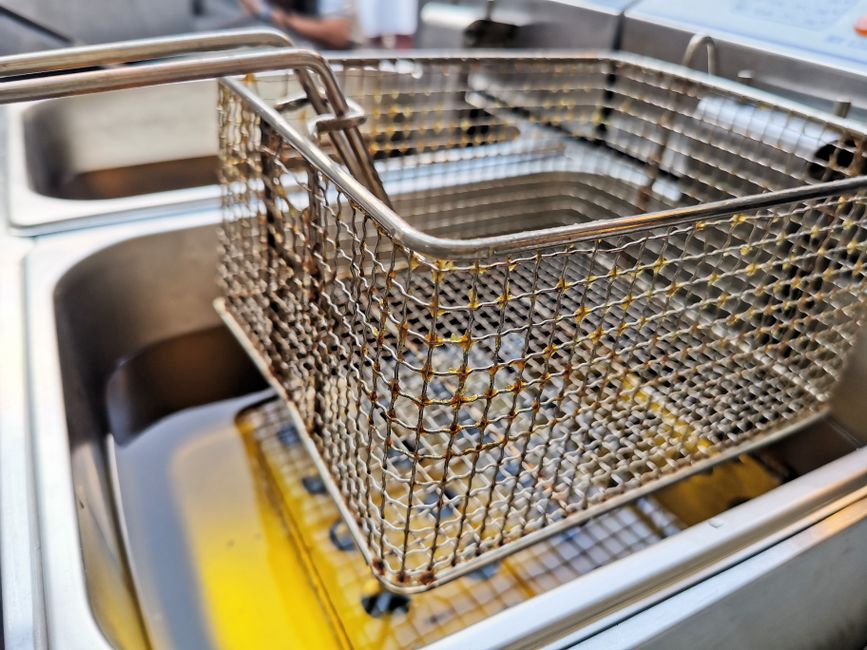
Ceramic coating wear is often gradual. Watch for:
- Visible scratches or scuffs, especially around basket edges where utensils contact most
- Food sticking in spots where it previously released — an early sign the coating’s non-stick properties are compromised
- Discoloration or pitting in the center, where heat is most concentrated
- Flaking or peeling — this is the clear endpoint; replace immediately
- A dull or rough texture where the surface was previously smooth, which suggests micro-abrasion of the upper coating layers
Is a Scratched Ceramic Basket Safer Than a Scratched PTFE Basket?
Probably yes — but “probably safer” isn’t the same as “fine to keep using.”
A scratched PTFE coating is a documented concern. Physical flaking means PTFE particles are entering your food. While PTFE is chemically inert in solid form and likely passes through the body unabsorbed, the degraded surface also off-gases more readily. The precautionary argument for replacement is clear.
A scratched ceramic coating exposes the aluminum substrate beneath. Aluminum leaching from cooking surfaces is a contested topic; current evidence suggests that cooking in aluminum increases dietary aluminum somewhat, but research hasn’t established a clear causal link to adverse health outcomes at typical dietary exposure levels. The precautionary position — avoid unnecessary aluminum exposure in high-heat environments — is reasonable either way.
A scratched ceramic basket is likely safer than a scratched PTFE basket. It’s still a compromised cooking surface. Once the coating is visibly damaged, replace the basket or the appliance.
Can You Replace the Basket?
Sometimes. Instant Pot sells replacement baskets for several Vortex models. Some Ninja configurations can be purchased separately. Cosori occasionally sells replacement parts through its website and Amazon.
Many brands don’t offer this at all. A failed basket means a new appliance — wasteful and expensive.
If repairability matters to you, check before you buy. Search “[model name] replacement basket.” If the results are sparse or lead only to third-party universal accessories, assume the basket is non-replaceable. Stainless steel baskets sidestep this entirely — since there’s no coating to fail, that particular replacement cycle doesn’t apply.
PFAS, PTFE, PFOA — What These Labels Actually Mean
These acronyms appear on packaging constantly. Many buyers use them interchangeably. Here’s what they actually mean.
PFAS is the umbrella category — thousands of synthetic fluorinated chemicals with extremely strong carbon-fluorine bonds. They don’t break down easily in the environment or in the human body, which is why they’re called “forever chemicals.” PFOA and PTFE are both types of PFAS, but so are GenX compounds, PFBS, PFNA, and hundreds of others. A PFAS-free claim is the broadest possible safety claim, but it needs to apply specifically to food-contact surfaces to be meaningful.
PTFE is the specific fluoropolymer used in Teflon and most conventional non-stick coatings. It’s technically a PFAS compound. A PTFE-free claim means no Teflon-type coating — meaningful, but it doesn’t rule out other PFAS compounds used as manufacturing processing aids.
PFOA was the chemical used to manufacture PTFE coatings for decades, linked to thyroid disease, certain cancers, elevated cholesterol, and immune system disruption. The EPA phased PFOA out of U.S. manufacturing by 2006 under a voluntary industry agreement. PFOA-free labeling is now effectively universal. Every reputable brand uses it, which means it conveys almost no useful safety information. A product can be PFOA-free while still containing PTFE and other PFAS compounds.
| Label | What It Actually Means | Trust Level |
|---|---|---|
| PFAS-free (explicitly stated for food-contact surfaces) | Broadest safety claim; rules out entire class of fluorinated chemicals | High — if specific to basket/tray |
| PTFE-free | No Teflon-type coating; rules out primary non-stick risk | High — meaningful and specific |
| PFOA-free | Phased out industry-wide since 2006; near-universal | Low — not a useful differentiator |
| “Eco coating” / “green coating” / “healthy coating” | No regulatory definition; marketing language only | Zero — treat as unverified |
| “Toxin-free” / “chemical-free” | Impossibly broad and undefined | Zero — red flag |
| NSF certified | Third-party food safety verification; strongest independent signal for cookware | High |
How to Verify a Manufacturer’s Non-Toxic Claims
Most buyers take manufacturer claims at face value. The alternative seems like a lot of work — but it’s actually a pretty short process once you know where to look.
Step 1: Check the manufacturer’s product page (not a retailer listing, which may copy specs loosely). Look for the material specification section. You want explicit claims applying specifically to the basket, tray, rack, and food-contact surfaces. “PTFE-free basket” and “PFAS-free food-contact surfaces” are the phrases to look for. Be skeptical of anything that says only “BPA-free” (a plastics concern, not relevant to metal cookware), “eco-friendly,” or “non-toxic coating” without chemical specifics.
Step 2: Check the PDF user manual, usually available on the manufacturer’s website. Look for sections titled “Product Specifications,” “Parts and Materials,” or “Care Instructions.” The care section often reveals more than the marketing copy — if it says “do not use metal utensils to preserve the non-stick coating,” that’s an implicit acknowledgment of a coating that can be damaged. If it specifies 18/8 stainless steel for the basket, that’s a positive signal.
Step 3: Email customer support if the manual doesn’t clarify. Ask specifically: “Can you confirm whether the air fryer basket and food-contact tray contain any PTFE, PFAS, or fluoropolymer-based coatings? I’m looking for documentation that these surfaces are free of all PFAS compounds, not just PFOA.”
A brand with genuinely clean products will answer this directly and may offer documentation. A brand that can’t answer — or sends boilerplate that doesn’t address the question — is telling you something useful either way.
Step 4: Look for third-party certifications. NSF/ANSI 51 (Food Equipment Materials) verifies that food-contact materials meet safety standards — not all brands pursue it, but those that have it carry a verifiable baseline. California Proposition 65 compliance is a secondary check: a product sold in California without a Prop 65 warning has cleared a meaningful (if imperfect) regulatory hurdle. Clean Production Action’s BizNGO framework goes deeper on supply chain chemistry for buyers who want to follow that thread.
What About Glass Bowl Air Fryers?
Halogen air fryers — the kind with a glass bowl and a lid unit containing the heating element and fan — represent a genuinely different approach. The cooking vessel is borosilicate glass: chemically inert, non-porous, and free of every coating concern that applies to metal baskets.
The appeal is real. Glass is the most chemically inert food-contact material available in consumer appliances. There’s no coating to degrade. You can see the food cooking, which helps with timing. At end of life, borosilicate glass is fully recyclable (though local infrastructure varies).
The practical limits are also real. Glass bowls are heavy and fragile — dropping the cooking vessel is a genuine risk. Capacity is typically 12–17 liters, large by volume but an awkward shape for some foods. Heat distribution can be less even than basket-style fryers. The market has also contracted significantly since 2015–2019; finding a current model takes more searching, and replacement glass bowls aren’t always available.
Glass bowl fryers suit larger households cooking full roasting portions, buyers who want absolute certainty about cooking surface inertness, and anyone comfortable with the format’s physical characteristics. They’re less suited to small kitchens, users with limited grip strength, or anyone who wants the compact design of a modern drawer-style fryer.
Which Air Fryer Material Should You Choose?
Choose Stainless Steel If…
Non-toxic food contact is your primary concern and you want to eliminate coating variables entirely. You cook frequently enough that longevity and replacement cost matter. You’re willing to put in slightly more effort with oil and cleaning technique. You can make the higher upfront investment and are planning to keep the appliance for years rather than months.
Budget $150–$250 for a reputable stainless interior model. Verify the basket is stainless, not just the housing. Use a light oil spray on the basket before cooking proteins and breaded items.
Choose Verified Ceramic If…
Budget constraints make stainless steel inaccessible right now. You’ve verified the specific model’s claims are PTFE-free and PFAS-free — not just PFOA-free. You’re committed to careful handling: silicone utensils only, hand washing, no abrasive sponges. You’re willing to monitor coating condition and replace the basket (or appliance) when degradation starts.
Budget at least $80–$100 for a quality model from a brand with explicit PFAS-free documentation. Avoid the cheapest options, where coating quality is most variable. Set a mental checkpoint to assess coating condition at twelve months.
Choose Glass If…
You want the highest material inertness and can accommodate the format’s limitations — larger portions, heavier vessel, less compact footprint. You’re comfortable searching a smaller market for available models.
If Budget Is the Real Constraint
If stainless steel is out of reach, that’s a real constraint — not a moral failing. A few practical paths:
A quality ceramic-coated model, treated carefully, can last significantly longer than a cheap one. Silicone tongs only, hand wash only, avoid acidic foods in direct contact. The coating’s lifespan is directly tied to how well you maintain it.
Perforated parchment liners create a barrier between food and the basket surface. They don’t eliminate all contact, but they substantially reduce direct food-to-coating interaction. They’re inexpensive, compostable without heavy grease, and widely available.
Buy secondhand. The stainless steel options hold up well over time, which means a used unit can still be excellent. A secondhand stainless model at $70 from Facebook Marketplace or eBay is a better health and sustainability choice than a new cheap ceramic-coated fryer.
If non-toxic cookware is a priority and you can wait, the long-term math supports it. A $180 stainless air fryer used for eight years runs about $22 per year. A $90 ceramic-coated one replaced every two years runs $45 per year — and generates four times the appliance waste.
Frequently Asked Questions
Q: Is ceramic coating safer than stainless steel in an air fryer?
When the coating is intact and verified as PFAS-free and PTFE-free, ceramic coating is considered a safer alternative to traditional non-stick. Stainless steel food-contact surfaces avoid the coating question entirely, which makes them the more straightforward choice for buyers who want to eliminate uncertainty. The risk with ceramic coating increases if the surface is scratched, chipped, or if the manufacturer’s non-toxic claims are vague or unverified.
Q: Does “PFOA-free” mean an air fryer is non-toxic?
No. PFOA is only one chemical within the broader PFAS family. A product labeled PFOA-free may still contain other PFAS compounds or PTFE-based coatings. For a more reliable safety signal, look for products that explicitly state they are PFAS-free and PTFE-free, with those claims applying specifically to the basket, tray, rack, or food-contact coating — not just the outer housing.
Q: Does stainless steel make food stick more than ceramic coating?
Yes — stainless steel has less inherent food-release than an intact non-stick coating. In practice it’s manageable: a light oil spray before cooking proteins, perforated parchment liners for breaded items, and allowing food to cook long enough to release naturally (the same technique used with stainless pans on the stovetop) all reduce sticking substantially. It requires more technique, but not dramatically more effort once you’ve adapted.
Q: How long does a ceramic-coated air fryer basket typically last?
With careful daily use — silicone utensils only, hand washing, no abrasive cleaning — a quality ceramic coating can last two to three years before visible degradation begins. With less careful use (dishwasher cycles, metal utensils, abrasive sponges), visible wear often appears within twelve to eighteen months. Cheaper coatings may show degradation faster regardless of care. Once the coating is visibly scratched, pitting, or flaking, replace the basket or appliance.
Q: Is a scratched ceramic coating dangerous?
A scratched ceramic coating isn’t in the same risk category as a scratched PTFE coating, but it’s not fine to keep using indefinitely. Visible scratches expose the aluminum substrate beneath. The evidence on dietary aluminum from cookware isn’t conclusive, but the precautionary case for not cooking on a damaged surface is reasonable. Visible flaking is the clear endpoint — replace at that stage.
Q: Is stainless steel actually better for the environment than a ceramic-coated air fryer?
Over a full lifecycle, yes — for most users. Stainless steel has a global recycling rate of approximately 85–90% and doesn’t require coating replacement cycles. Ceramic-coated aluminum is harder to recycle because the coating must be separated from the metal substrate, and many facilities don’t process it separately. More importantly, a stainless steel basket significantly outlasts a ceramic-coated one, meaning fewer replacement purchases and less appliance waste over the same period.
Q: Can I just replace the basket when the ceramic coating wears out, or do I need a whole new air fryer?
It depends on the brand and model. Instant Pot, some Ninja configurations, and Cosori occasionally sell replacement baskets. Many brands don’t, which means a failed coating forces a full appliance replacement. Before purchasing any air fryer, search “[model name] replacement basket” to confirm the option exists. If results are sparse or lead only to third-party universal accessories, assume it’s non-replaceable and factor that into your decision. Stainless steel baskets, which have no coating to fail, sidestep this issue entirely.
The Bottom Line
If you want the simplest possible answer on non-toxic food contact, stainless steel wins. No coating means nothing to degrade, nothing to off-gas, nothing to flake, and no manufacturer claims to independently verify. You pay more upfront and manage slightly more technique in the kitchen. Over eight or ten years, you come out ahead financially, and you haven’t sent three air fryers to landfill in the meantime.
If budget is the real constraint, a verified ceramic-coated model — PTFE-free, PFAS-free, handled carefully — is a reasonable middle ground. Just be honest with yourself about the maintenance commitment, check whether replacement baskets exist before you buy, and don’t let “eco coating” language on the box substitute for actual documentation.
The worst outcome here isn’t choosing ceramic over stainless. It’s buying based on vague “non-toxic” marketing and replacing the appliance every eighteen months without thinking twice about it. That cycle is what this guide is trying to help you avoid.